Breast Ties in Shibari: Framing the Chest with Feeling, Not Force

I keep getting asked about this one, in class and in my inbox: "Anastasia, how do I tie the breasts so it looks like that?" - usually with a photo of some gorgeous rope-bra attached. So I finally sat down to write it all out.

Here is the honest version. Breast ties are some of the most beautiful, most felt ties in all of shibari - and they are also some of the most misunderstood. People think the danger is the breasts themselves. It isn't. The breasts are soft tissue, they can take a lot of loving pressure. The risks live somewhere else entirely, and I'll show you exactly where, because that's the part a good rigger actually checks for.
So let's talk about what these ties are, how they feel from both sides of the rope, and how to tie the chest in a way that frames a body beautifully without ever putting it in harm's way.
What we even mean by a "breast tie"
When people say breast tie, shibari bra, or breast bondage, they're usually pointing at one of a few ideas. And here we will talk about the classic one. The V shaped shibari chest harness.
Which is the shinju. My Japanology brain can't resist telling you that 真珠 literally means pearl - a lovely name, isn't it? A shinju is the classic two-band frame: one wrap of rope above the breasts, one wrap below, so the breasts are gently cradled and lifted between them. That's it. Two bands. It looks like so much more than it is, which is exactly why I love it.
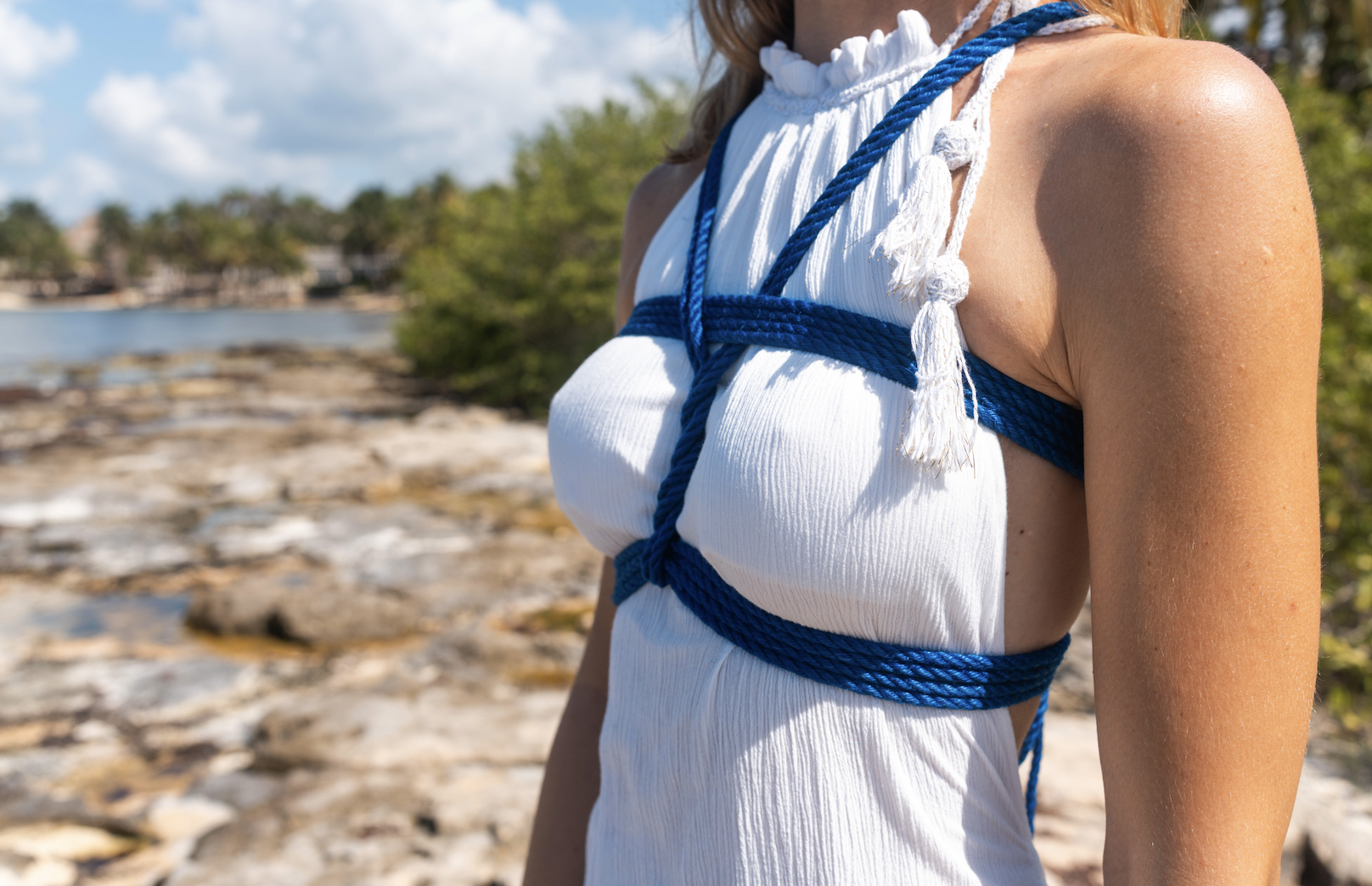
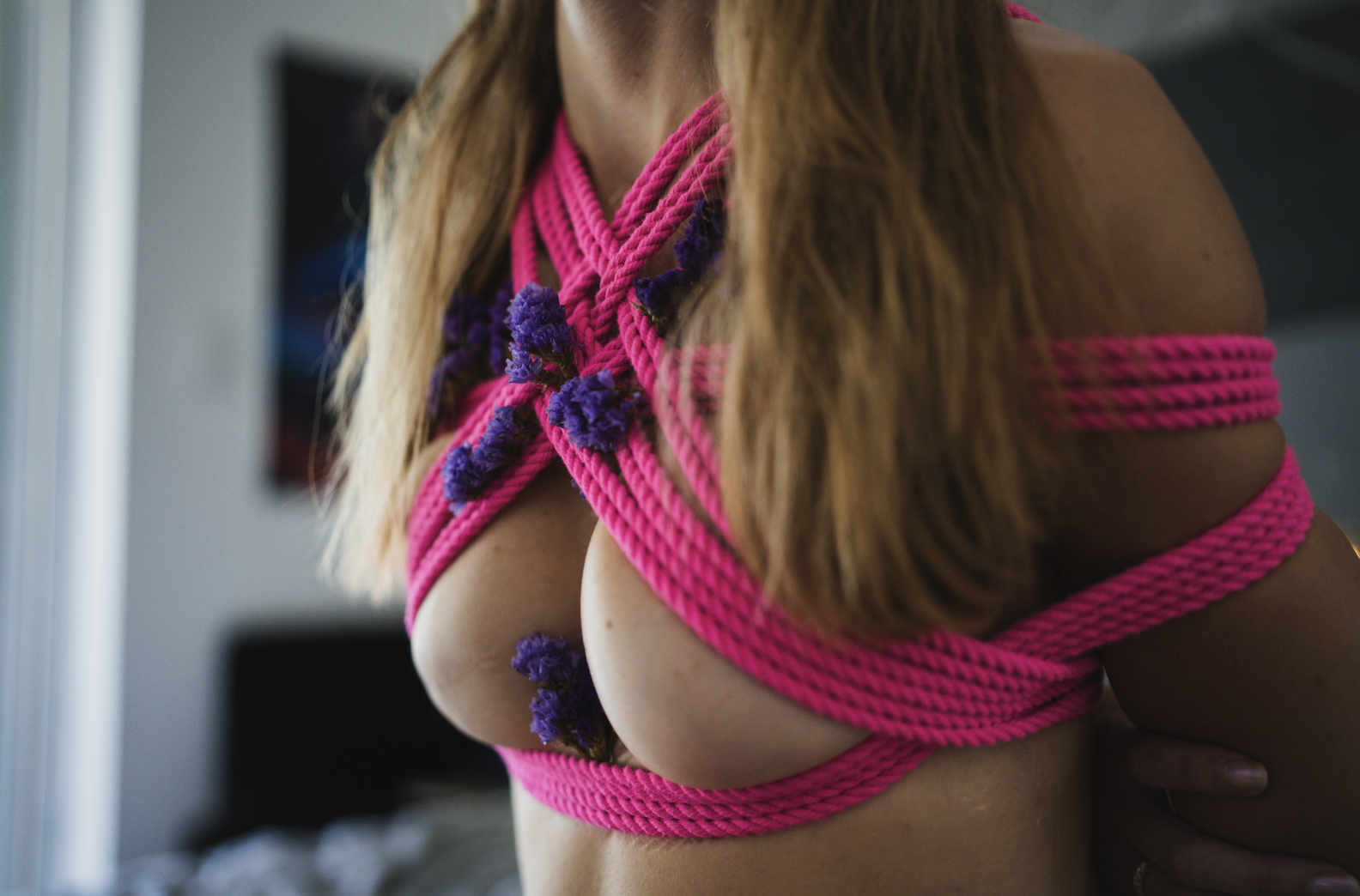
Also, there is everything we lump under the rope bra - the woven, decorative patterns that actually cup and cover, the ones that make your model feel like she's wearing a real piece of clothing. In my practice these grow out of ties like the mermaid, the diamond, and the triangle bra. I've collected a whole pile of those in my 16 chest harness tutorials, so I won't repeat every pattern here - here I want to talk about the body underneath them.
Because here's the thing I tell every student: a breast tie is not a shape you install on a person. It's a conversation with a specific chest, on a specific day. Hopefully this article will help you with your first classic one!
What it actually feels like (from both sides of the rope)
For the model, a good shinju feels like being held. The two bands hug the ribcage, the breasts are lifted and framed, and there's this quiet, grounding pressure that a lot of people find deeply calming - the same slowing-down that pulls you into the present. Skin gets more awake. Breath gets slower and, honestly, a little more conscious - you notice you're breathing, which is half the magic. Many of my models describe it as feeling suddenly, warmly seen.
And yes - it can be erotic, it can be tender, it can be neither. A breast tie doesn't have to be a BDSM thing at all. It can just be a beautiful, sensual way to explore your own chest and breath. Rope is generous like that.
For the person tying, it's slower and more attentive than it looks. You're not performing knots - you're watching skin colour, listening to breath, feeling where the ribcage moves. Rope becomes an extension of your hands. You place a band, you smooth it, you ask "how's that sitting?", you adjust. The whole thing is a gentle back-and-forth dance, not a construction project.
If you ever feel like you're fighting the body to make a shape happen - stop. The body isn't wrong. The plan is.
The part everyone skips: where the real risk lives
Here's the misconception I most want to kill. As I said - breast tissue is soft and forgiving. It is not where breast ties go wrong.
Breast ties go wrong at the anchors and edges - the places where the rope has to grip the skeleton to hold the pretty part up. So this is where I actually put my attention:
The upper band and arm-pits... and the collarbones
The band that sits above the breasts likes to creep up toward the armpits and maybe even collarbones. Keep your rope off the armpits. It always needs to be a bit below it, not on it.
Wraps that pass high under the arms can press into the armpit, and that region carries nerves and vessels feeding the whole arm. If your model's hands start tingling or going cold after you set a chest harness, look here first, not at the breasts. Nerve issues love to arrive without pain - that's what makes them sneaky. If you want the full, sobering version of why I care so much, read my honest account of nerve damage and how to avoid it. It cost my model the use of her hand for over a week. I don't tell that story to scare you - I tell it so it doesn't happen to you.
Collarbones are sensitive for some people. Try not to put the rope perpendicular to it, but at an angle.
Breathing
Some chest ties compress the ribcage - that's part of what makes them feel so present and enveloping. Lovely. But it means you keep checking that your model can take a full, easy breath, talk in a normal voice, and sigh out completely. A breast tie should hug the breath, never fight it.
Circulation, the same as always
Colour changes, coldness, pins-and-needles that don't settle when you shift - all the usual flags. My whole safety philosophy fits in one warm little rule I repeat constantly: if it tingles or goes numb, free it up! And keep your safety shears within reach - always, every single time, non-negotiable. This is the kinky version of reading the manual, and it's way more important.
The two-finger rule, in the place it matters most
Every breast tie I teach lives or dies by this: once a band is set, you should be able to comfortably slide two fingers between the rope and the body. Not one. Two.
On the chest I check this in three spots - the upper band, the lower band, and anywhere the rope crosses over the shoulder or under the arm. If two fingers slide in easily, you have room to breathe, room to shift, room for the tie to be comfort and safety rather than a countdown. If they don't, you undo and re-lay the band. No ego, no "it's basically fine." Untie it and try again - the same way I tell students a single column that doesn't look right should just be redone.
How to actually build a simple shinju chest harness
A shinju is really just two bands anchored front and back, so if you can tie a clean single column and a ladder tie, you already have the whole vocabulary. Here's the shape of it, in plain steps (very condensed, watch an attached video for the detailed instruction):
Talk first. Ask about any old shoulder or chest injuries, surgeries, or nerve trouble, and agree on how she'll tell you the moment something's off. Communication before the rope - always.
Lay the lower band around the ribcage, just under the breasts. Snug and even, not tight. Smooth out every twist as you go - twists become pressure points.
Lay the upper band across the top of the chest, above the breasts and below the collarbones. This is the band you watch like a hawk so it never creeps onto the shoulders.
Connect front and back with a V shape so the two bands support each other and the breasts are framed between them.
Check everything. Two fingers under each band. A full breath. Wiggle the fingers. "How does that feel, honestly?" Then adjust, because there is always something to adjust.
That's the bones of it.
Here is a tutorial of this tie:
Every chest is different (yes, really)
There is no ultimate tie that fits everyone - I say this about "gotes" and I say it just as loudly about breast ties. Bodies are gloriously varied: different sizes, different softness, different rib shapes, breasts that sit differently, skin that marks more or less easily. A band placement that frames one chest perfectly will slide or dig on another.
So please don't chase the exact photo. Chase your model's body. Ask where the rope wants to sit. Let the tie be 50% hers - because she's the one wearing it and feeling every millimetre. The rope bunny is a partner, not a prop, and on a tie this intimate that's not a slogan, it's the whole method.
When the ropes come off
A breast tie is a lot of sensation, sometimes more than people expect, and it can open up something tender. So don't treat the untie as the end. Slow down, keep contact, offer water, a blanket, some quiet - a little aftercare (chocolate, anyone?). And a next-day check-in is a beautiful habit: "Hey - any tingling, any marks that worry you?" It tells your partner the care didn't stop when the rope did.
Where to go from here
If all of this makes you want to actually put rope on skin, start with the fundamentals rather than the fanciest bra you've seen online - the clean bands, the safe placements, the checks that become second nature. That's exactly the ground my beginner-friendly Shibari Discovery Course is built on, essential knots and safety first, so your first breast tie is one you'll be proud of and one that keeps your partner safe.
Because with the chest, more than almost anywhere, safety isn't the opposite of sexy - it's the whole foundation of it.

Written by
Anastasia
I feel that it's time to share my approach to shibari with you! I have been discovering shibari for myself for 6 years, constantly learning and developing my own style.