Decorative Chest Harnesses: Heart, Butterfly, Star, Diamond, and Ladder Patterns
Every time I post a new harness, I get the same question in my DMs: "Anastasia, which harness should I tie for my photoshoot / my date / my festival outfit?!" I keep answering one by one, so finally I sat down and wrote it all in one place.
These five patterns - heart, shinju, star, diamond, and ladder - are the decorative chest harnesses I come back to again and again in performances, photoshoots, and sessions. Not because they are the most complicated (they are not!), but because each one has its own character, its own feeling on the body, and its own perfect moment. Let me walk you through them the way I would in class.
If you want the full buffet of designs afterwards, I collected 16 of my favorite chest harness variations in a separate post - this one goes deeper into the named patterns you guys keep asking about.
What do I mean by "decorative"?
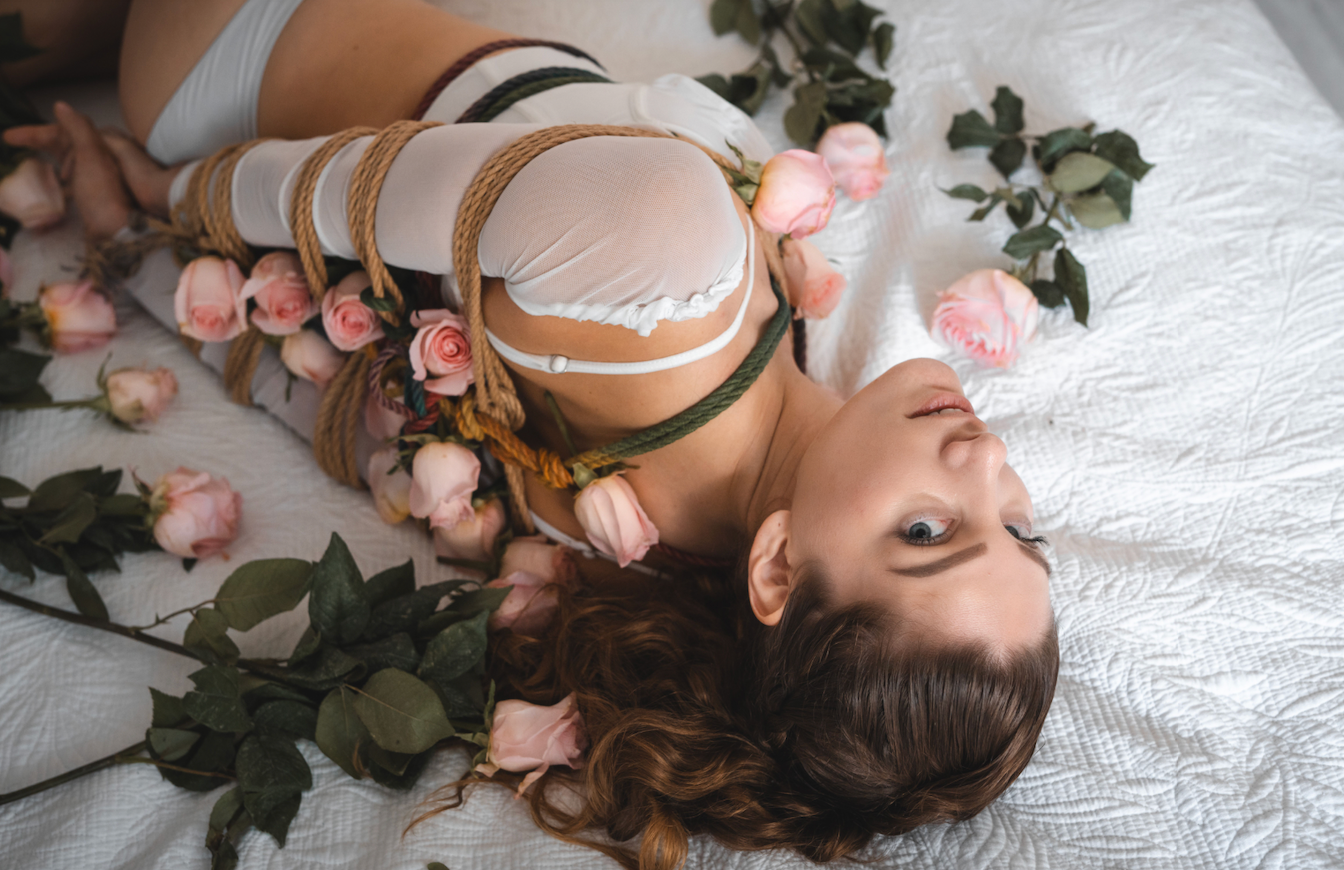
A chest harness is a tie that lives on the chest area - it doesn't extend to the hips and usually doesn't involve the arms. "Decorative" means the pattern exists for beauty and sensation, not for holding weight. None of the harnesses below are suspension ties! They are for floor work, for photos, for dancing, for feeling the rope hug.
But decorative does not mean "less serious." The rope is still on a living, breathing body. More on that at the end - first, the fun part!
Before you tie: the boring-but-important part
All five patterns are built from the same small vocabulary: the single column tie, half hitches, nodomes (munter hitches), and clean tension. If your single column doesn't look like a little heart yet - practice that first, everything else will come much easier, believe me!
And my forever rule: you should be able to comfortably slide two fingers between the rope and the body. Decorative harnesses can be worn for a long time - at a shoot or a festival that can be hours - so a too-tight wrap that feels "fine" in minute one becomes a problem in minute forty.
The Heart Harness - for romance (and Valentine's Day, obviously) (heart element)
Love is in the air? Well, it will be if you tie this one! The heart harness draws a heart shape right on the sternum using nodomes and half hitches, and it's simpler than it looks - the shape does all the work for you.
When I use it: romantic sessions, couples' dates, anniversary photoshoots. The pattern sits on the front of the chest, so it photographs beautifully face-on, and your partner gets to look down and see a heart made of rope on their own body.
Body notes: the heart sits on the chest, and can be placed according to the model's body. So it works on absolutely every body - flat chests, big chests, everyone gets a heart. If your model has a larger bust, you can pull the lower wraps into a bra-like support underneath and add more wraps for support, which most models find genuinely comfortable.
Sing in to YT to see the video =)
The Candelabra Harness - complicated one, but so worth the work
If someone wants to have a very beautiful dress up harness, this is the one! It takes a while to make, but it sits on the body perfectly, you can comfortably wear it for a while.
When I use it: long performances where the model needs to move and dance, models with sensitivity, anyone who wants to wear rope for hours without pins and needles.
The Star (Pentagram) Harness - for the stage
The classic pentagram! It is fairly simple to make, endlessly popular, and honestly a must-know for any shibari enthusiast. Five points, one continuous logic, and a shape that reads clearly even from the back row of a venue.
When I use it: performances, festivals, Halloween shoots (of course).
Body notes: here is the secret craft lesson hiding inside the star: symmetry is unforgiving. Every leg of the star must carry the same tension, or the whole shape pulls crooked - and everyone will see it. So the pentagram is secretly one of the best tension teachers I know. When you're ready to level it up, you can build a corset into the pentagram for a dramatic waistline. So, check your tensions!
The Diamond Chest Harness - the classic that started it all
The diamond is THE shibari pattern. In Japanese the diamond shape is called hishi 菱 , and the hishi pattern is what most people picture when they imagine shibari at all. Build it with nodome knots and half hitches - simple, but oh-so pretty.
When I use it: everywhere, honestly. It's my default for beginners' first "wow" moment, my go-to for photoshoots when I don't know the model's body yet, and one of the few patterns here you can comfortably self-tie. And when you want more, the diamond doesn't stop at the chest - extend it down the body and you have the famous hishi karada, the full-body diamond tie. I made a whole karada tutorial with four variations if you want to go there.
Body notes: diamonds are the most forgiving pattern of all - the shapes stretch and adjust to any body. Every body wears the hishi differently, and that's exactly the point. There is no wrong body for a diamond!
The Ladder Tie - the quiet teacher
The ladder is the least flashy pattern on this list, and I love it for exactly that reason. Even rungs of rope climbing up a limb or the torso - it looks clean, unties quickly, and it will teach you more about tension than any other tie here. Lose your tension on rung three, and rungs four through eight will show it. The rope doesn't lie ;)
When I use it: self-tying practice (tie a ladder on your own thigh and you will immediately understand how your model feels the rope), warm-ups before a session, and festival wear - a ladder down each leg with glitter is a whole outfit, trust me. It's also one of my five must-know ties for beginners, so if you learn only one pattern from this post, make it this one.
So... which pattern for which occasion?
Honestly? There is no single right answer - every body is different, and half the joy is finding out what YOUR body (or your model's) loves. But after years of tying for stages and cameras, here is how I choose:
Romantic session or date - heart. The meaning is the pattern.
When you need extra pretty & complicated - candelabra.
Stage, festival, anything seen from far away - star. Bold shapes win.
First harness, photoshoot, self-tying, "just because" - diamond. The classic never fails.
Learning tension, warm-ups, festival arms - ladder. The quiet teacher.
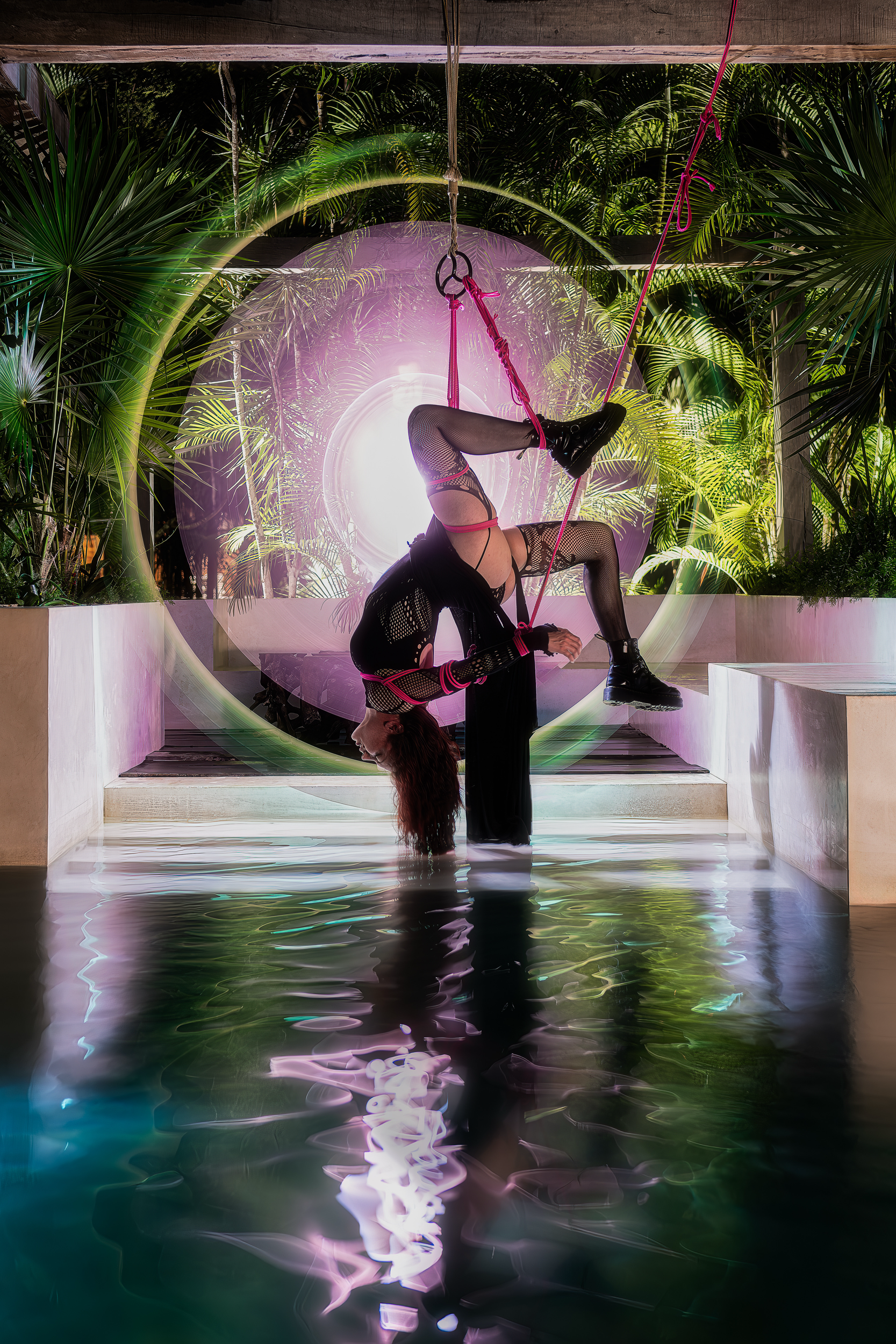
And for festivals specifically - decorative harnesses genuinely work as wearable art. Add boots and lots of glitter! Here is one of my decorative festival harnesses in action:
Decorative doesn't mean risk-free
One more time, with love, because I will never stop repeating this:
No tension on the neck. Ever. Route your rope over the shoulders, not against the throat.
Two fingers under every wrap. Especially if the harness will be worn for hours.
Tingling or numbness? Free it up! Immediately, not "after this photo."
Safety shears within reach. Even for a one-minute tie.
Check in. Before, during, and the next day. The person in the rope is your partner, not only your canvas.
If any of this is new to you, please read my guide on keeping rope play sexy and smart before you tie on a person. Because safety isn't the opposite of sexy - it's the foundation of it!
Make the pattern yours
Here is my favorite thing about these five harnesses: they are not sacred choreography. They are starting points. Change the knots, add openings, pull the upper wraps into a bra, merge a star with a corset, let a heart grow wings... The pattern on paper is 50% - the other 50% is the body in front of you and what it tells your hands.
A great exercise: draw a simple shape on paper first, then translate it onto the body. That's how most of my own designs are born! And if you want to build the foundations properly - the knots, the tensions, the safety - so you can design your own patterns instead of copying others, that's exactly what I teach in my Shibari Discovery course.
Happy tying! ❤️

Written by
Anastasia
I feel that it's time to share my approach to shibari with you! I have been discovering shibari for myself for 6 years, constantly learning and developing my own style.