What Is Kinbaku? Meaning, History, and How It Feels Different in the Ropes
Written from my own practice and my years going back and forth to Japan - not a dictionary entry, and definitely not the final word on anything.
So, what is kinbaku?
Short answer? Japanese rope bondage. Tight binding. That's the definition you'll find everywhere, and it's not wrong.
Long answer? It depends who you ask, and it depends whether you've ever felt it. Because for me, after more than 10 years of tying, kinbaku stopped being a word I could look up. It became something I recognize in my hands when a session goes a certain way.
And it depends, because people use rope for such different things. For some it's meditation - a way to breathe, slow down, and drop out of the noise. For some it's connection, pure and simple. For some it's beauty - the patterns, the photos, the performance. And for others it is absolutely sexuality and sensuality - skin, tension, desire. So kinbaku can be a very subjective thing: it becomes what you use it for and how you perceive it, and honestly, all of those versions are real. But (and this is a big but) we can't forget where it comes from. Its roots are in restraint first, and in eroticism second. The word carries that history whether we like it or not.
I keep getting this question from you guys, so let me actually sit with it. Not the shibari-vs-kinbaku debate (I already wrote about that little argument between the Japanese and the Westerners - go read it if you want the kanji). Here I want to tell you what kinbaku means as a practice, where it comes from, and what honestly changes in the room when the intention is kinbaku.
The word itself
Let me show off for one second (I didn't get my Japanology degree for nothing, right?!).
Kinbaku 緊縛 means tight binding. 緊 kin - tight, tense, taut. 縛 baku - to bind, the same character that lives inside the verb shibaru, to tie. So the word carries tension in its very body. Not just "rope on a person," but rope that holds, that grips, that means it.
The word is actually younger than you'd think. It was more or less invented to name exactly Japanese erotic rope bondage - to give it its own name, separate from tying up a parcel or tying a boat. In Japan, honestly, people use kinbaku and shibari almost interchangeably, and most Japanese teachers will say there's no difference.
But here's the thing - I think we build that philosophy of 2 different words ( shibari vs kinbaku) because we felt something and needed a word for it. And kinbaku, with its tightness and its tension baked right into the characters, is the one that fits.
Where it comes from: the thread from hojojutsu
Kinbaku didn't fall from the sky. It has a lineage, and the lineage is not romantic at all.
When I first got into rope - I was a weird university kid majoring in Japanology - I had a history professor who once showed our tiny class a picture of people tied up elaborately on a ship. I asked him what the knots meant, and he lit up and sent me pages and pages of research. That was hojojutsu 捕縄術: the martial art of restraint. The way samurai-era warriors bound prisoners with rope.
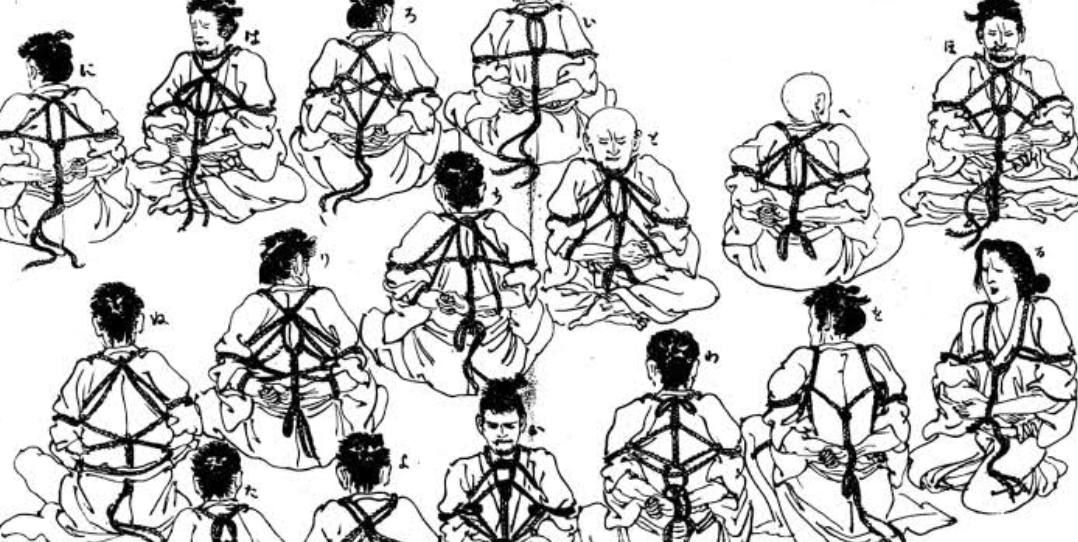
Hojojutsu was practical, sometimes brutal, sometimes strangely beautiful. Different ties for different ranks of prisoner, ties designed to hold a body without causing (accidental) death, ties that could even signal a person's crime by their pattern. It was about control and communication through rope - long before anyone thought of it as erotic.
Over the Edo period and after, as Japan modernized and this restraint art lost its policing job, its aesthetic and its psychological charge drifted into theater (kabuki loved a rope scene), into shunga (erotic woodblock prints), into photography.
Seiu Ito - the father of kinbaku
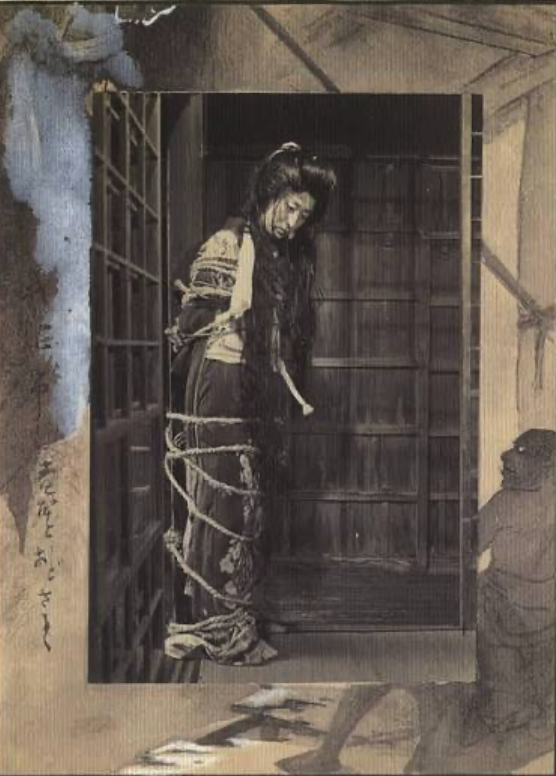
And then comes the man usually called the father of kinbaku: Seiu Ito 伊藤晴雨 (1882-1961). He was a painter obsessed with the old seme-e - the "torture pictures" of the Edo period - and he did something scandalous for his time: he actually studied the historical hojojutsu ties and started recreating those scenes with living models. Tying them, photographing them, painting from the photographs. He famously tied and suspended his own wife Kise (yes, even while she was pregnant). You can argue about his ethics all day, and people do. But with Ito the rope officially crossed the line: from restraint to eroticism. From punishment to art about the strange beauty of a bound, surrendering human being.
Kitan Club and the postwar fetish magazines
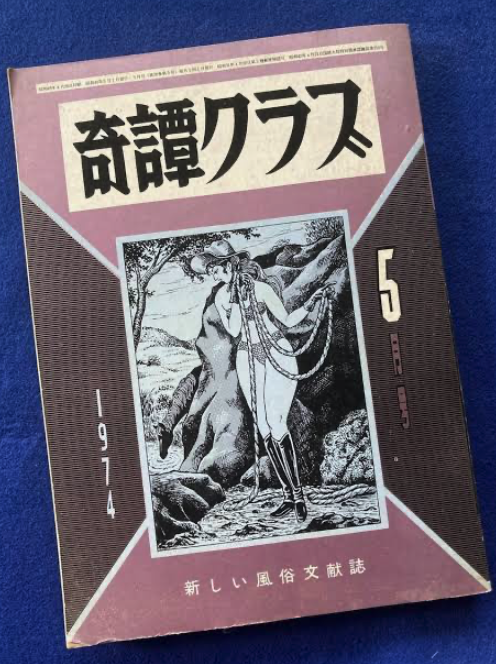
Then the war ended, censorship loosened, and the magazines arrived. In 1947 a little magazine called Kitan Club 奇譚クラブ - literally "strange tales club" - started publishing in Osaka, and by the early 1950s it had become THE home of kinbaku. Ito's work appeared in its pages. So did Minomura Kou, who wrote, edited, and tied under more than one name, and a young Nureki Chimuo, who would grow into one of the most influential bakushi (rope masters) of the century. And Kitan Club wasn't alone - there was Uramado ("rear window"), Fuzoku Soshi, later SM Select and SM King - a whole shelf of postwar fetish magazines where artists, photographers, and riggers were basically inventing the visual language of modern kinbaku, issue by issue.
Before the internet, this is how the knowledge traveled: somebody bought a magazine, stared at the photos, and tried to puzzle out the ties at home. (Sounds familiar, Instagram generation? We haven't changed that much!)
The first masters
From those pages came the masters who took rope off paper and into rooms and onto stages. Eikichi Osada, who more or less created the live SM show and is often called the father of modern kinbaku performance. Akechi Denki, legendary for his skill and his humor. Nureki Chimuo again, tying for films and photo books across decades. Later Yukimura Haruki, with his soft, seductive, "caressing" style that proved rope doesn't have to be harsh to be deep. Their students - and their students' students - are the teachers tying and teaching today, including the people I've had the luck to learn from in Japan.
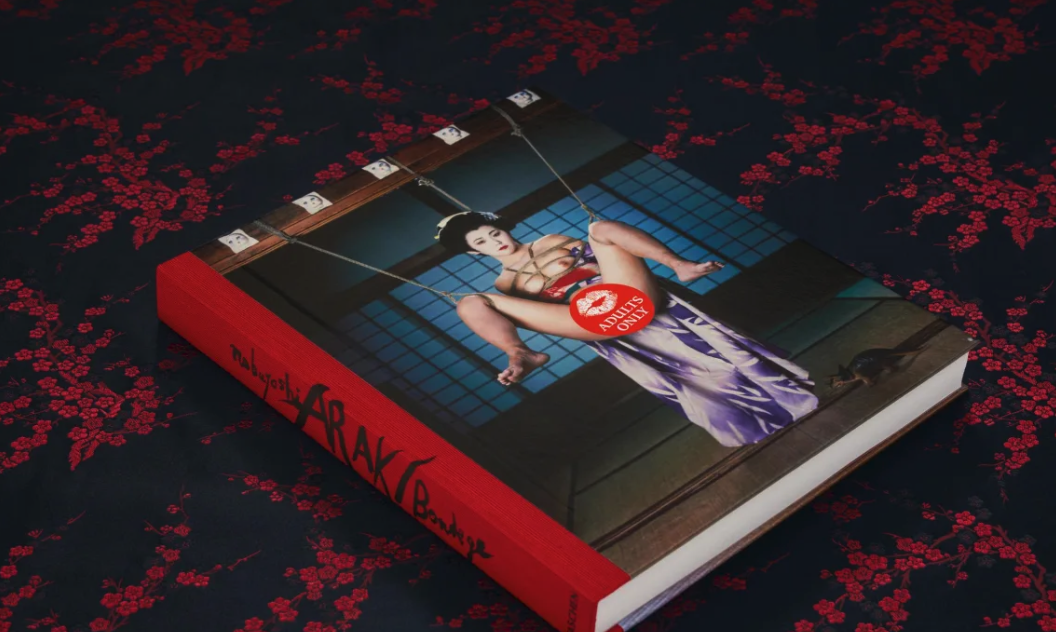
And then the photographer Araki Nobuyoshi put tied bodies in front of the whole Western art world, and the thread finally reached us. Together they turned that old vocabulary of restraint into a vocabulary of intimacy.
I'm compressing centuries into a few paragraphs and I know it (this is not a comprehensive history, please don't quote me in an exam). But I want you to feel the thread: kinbaku carries the DNA of a practice that was always about one person having another person's body in their hands, and being responsible for it. That responsibility never left the rope. We just changed what we do with it.
If the vocabulary here is new to you - I keep a plain-language list in my shibari vocabulary guide.
So what actually changes when the intention is kinbaku?
Okay. This is the part you actually came for.
You can put the exact same rope on the exact same body with the exact same knots, and get two completely different things. The knots don't decide it. The intention does.
When the Western world separates the words, it usually goes like this: shibari points outward - the shape, the pattern, the photo, the performance. Kinbaku points inward - what is happening between the two people. Shibari can be just tying. Kinbaku is having an actual emotional rope session.

I live on both sides of this. I shoot beautiful images, I perform, I absolutely love a gorgeous pattern. But when I say I'm doing a shibari session, here is what's different in my hands and in the room:
The rope slows down
Everything gets slower. In a shibari session I'm not rushing to the finished harness - the finished harness is almost beside the point. I'm noticing the breath. I'm noticing the little shift in weight, the flicker of a muscle. And here's the secret my students hear me say all the time: slowing down doesn't cool the fire - it feeds it. The tension has room to build. That delicious kind.
The rope becomes an extension of my hands
This is the metaphor I come back to endlessly, because it's just true. In a kinbaku session the rope stops being a separate object I'm applying. It becomes an extension of my hands, of me - so that every wrap is really me touching, holding, asking a question of your body and waiting for the answer. It's a silent dialogue. A slow dance where nobody agreed on the choreography beforehand.
The tied person is a partner, not a prop
This is the ethical heart of it, and it comes straight down that thread from hojojutsu - you are responsible for a whole human being. In kinbaku the person in the rope is not a mannequin I'm decorating. A tie is at least 50% them (more, really, since they're the one enduring it). Their sensations, their surrender, their "a little tighter here" or "let it out" - that's not interrupting the art. That IS the art. There's a saying in rope I love: tying someone is a privilege, not a right. You earn it with care.
Presence becomes the whole point
When it works, both people drop into the present completely. The one in the rope gets to let go of every responsibility and simply feel - the ropes wake the body up and quiet the mind at the same time. The one tying gets pulled into that same present, catching every little detail. That shared drop into now - THAT is what I mean when I say "kinbaku." Not a knot. A state you enter together. If you want to read more about that state, I wrote about it in Shibari: A Journey to the Present and about rope as connection play.
To truly get kinbaku/shibari (whichever word you decide to use) you don't need to know every intricate knot. You need to understand the principles of rope handling, and then you need to bring intention. A very simple tie, done with total presence and connection, is far more kinbaku than a dazzling complex harness done while you're staring at a diagram and ignoring the person underneath it.
Want somewhere concrete to start? Learn to lay a clean single column, learn to feel your tension, and build from there. My Shibari Discovery Course is built exactly around that idea - designing from principles instead of copying choreography.
The tightness is real - so is the risk
Remember, kin means tight. Kinbaku genuinely does play with pressure on the body, and that means it can hurt someone if you're careless. As you all know by now, shibari is a dangerous activity - I don't say that to scare you, I say it because I once watched drop hand happen to my own model after almost seven years of tying, and I never want you to feel that.
So the old refrains, always:
You should be able to comfortably slide two fingers between the rope and the body.
If it tingles or goes numb, free it up - that's a red flag, not a phase to push through.
Safety shears within reach. Always. Bathroom break? Check the ropes. Long pause? Untie.
Talk before, talk during, and check in the next day - that next-day message is aftercare too.
And please, do NOT jump to suspension because it looks cool on Instagram. Rope experience lives beautifully on the floor.
Because safety isn't the opposite of the sensual, tight, intimate thing you came here for. It's the foundation of it. I go deeper on all of this in Is Shibari Safe? and in my piece on avoiding nerve damage - read them, really.
So, what is kinbaku, in the end?
It's a word that means tight binding. It's a practice with a long, unglamorous, fascinating root in the art of restraint. And it's - for me - the moment rope stops being decoration and becomes a conversation: slow, tight, present, fully consensual, and completely alive.
A kinbaku experience doesn't have to be a heavy BDSM thing, by the way. It can be a story. It can be art. It can be two people tying a situation in which someone gets to feel safe, held, and happy. That's the version I fell in love with, and the version I keep trying to show the world.
And if this thread from old Japan is pulling at you - go feel it in your own hands. Best luck with rope! ❤️

Written by
Anastasia
I feel that it's time to share my approach to shibari with you! I have been discovering shibari for myself for 6 years, constantly learning and developing my own style.