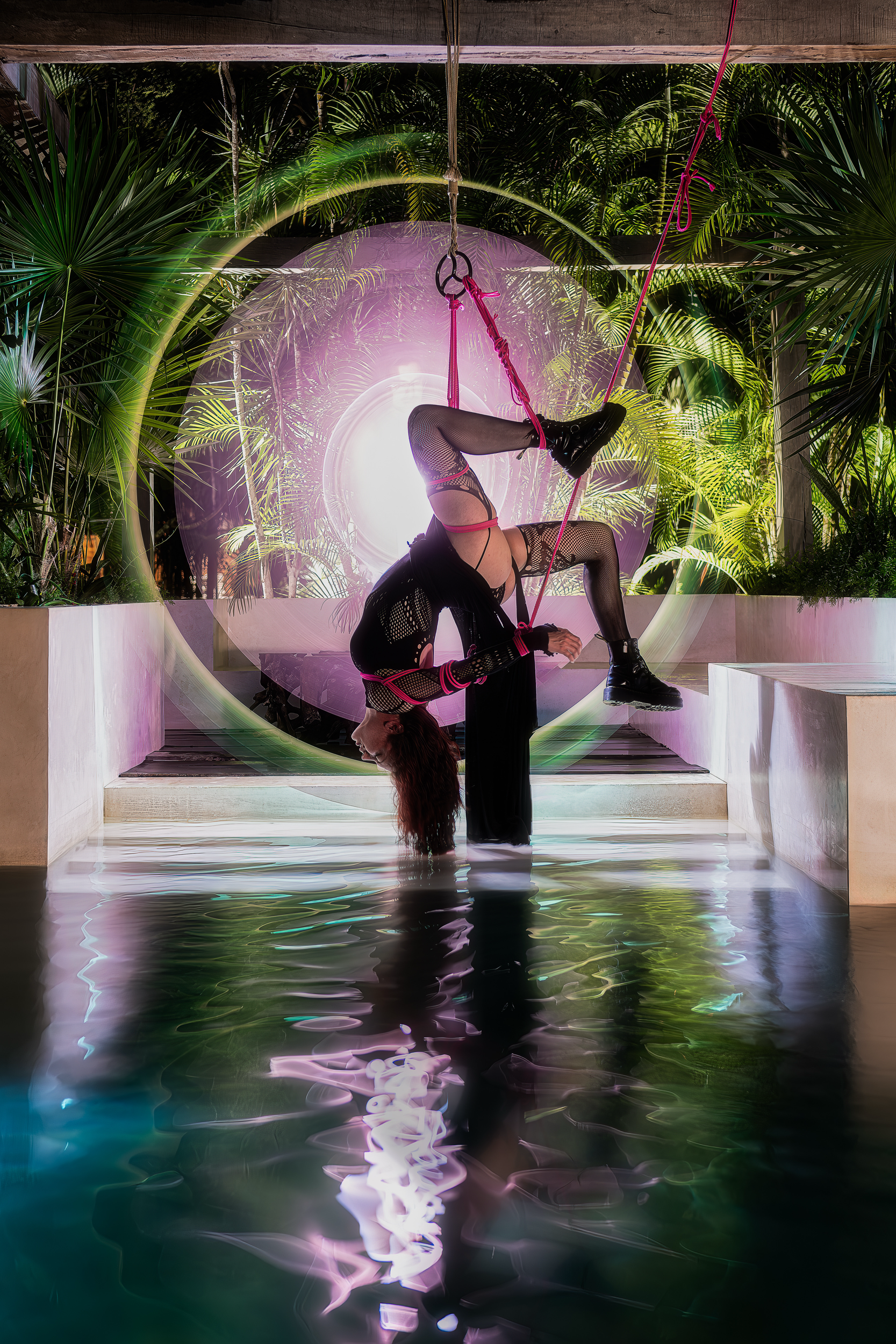
What Is a Rope Bunny? The Role, the Name, and What It Actually Feels Like

Two questions reach me more often than any others - at workshops, in my inbox, from people who just discovered rope: what is a rope bunny? And, almost as often: why is the person being tied called the bunny? After years of tying, teaching, and being tied myself, I decided to answer both properly - not as a dictionary entry, but from experience.
Short answer? A rope bunny is the person being tied in shibari (Japanese rope bondage) - the one in the ropes, not the one holding them.
Long answer? It's so much more interesting than that. Let's go!
The Rope Bunny Meaning: A Simple Definition
In the rope community, the person who ties is called a rigger (or rope top), and the person being tied is called a model, a rope bottom, or - playfully - a rope bunny.
The term "rope bunny" is affectionate slang. It implies someone who loves hopping into rope - someone who enjoys the sensations, the surrender, the experience of being the living canvas for rope art. Some people relish the physical side (the tightness, the squeeze, that floaty feeling of a good tie), others come for the emotional ride - trust, vulnerability, adrenaline, zen. Usually it's both!
And since I need to prove I didn't get my degree in Japanology for nothing (right?!) - the Japanese terms are 縛り手 (shibarite - the rigger, literally "shibari hand") and 縛り受け (shibariuke - the model, literally "shibari receiver"). One gives the rope, one receives it. I love how clean that is: no bunnies, no hierarchy, just two halves of one experience.
Rope Bunny vs Rope Bottom vs Model - Which Word Should You Use?
Honestly? It depends on the person, so ask them.
Rope bottom is the neutral, general term - safe in any context.
Rope bunny is the cute, playful one - many people adore it and proudly put it in their bios, but some find it a little diminutive, especially in professional or performance settings.
Model is what I use most in my photography and performance work - it centers the artistry.
None of these is "the correct one." I have partners who giggle at "bunny" and partners who prefer "model," and both are right - about themselves. If you're new to a rope community (a rope jam), start with "rope model," and switch to "bunny" when the vibe (or the person) invites it. Etiquette in rope is really just care wearing a different outfit ;)
What a Rope Bunny Actually Does (Hint: It's Not "Nothing")
Here is the biggest misconception I want to untie: being a rope bunny does not mean being passive.
Rope bunny = Partner, not prop.
A great rope model is an active participant in the scene. You negotiate what you want before the rope comes out. You communicate during the tie - "my left hand is tingling," "I can take this tighter," "I need a moment." You adjust your body, you breathe with the rope, you bring your own energy and story into the shape. I always tell my students: a tie is 50% the person in the ropes - if not more, since you're the one who endures it!
Without you, the rope is just a coil on the floor. You are the reason it becomes art.
(This is one of my Shibari TV episodes - what shibari models wish every rigger knew. If you're a rigger reading this, watch it twice!)
What Being in the Ropes Actually Feels Like
This is the part no definition can give you, but let me try.
When the rope starts moving around your body, something shifts. You can't check your phone. You can't plan tomorrow's meetings. The ropes awaken your body and quiet your mind at the same time - you concentrate on sensations, on your partner's breath on you, on the sound of jute sliding over jute. While your body surrenders, your mind arrives fully in the present, catching every little detail.
Many rope models describe drifting into "rope space" - a relaxed, floaty, almost meditative altered state. Some people cry (a good cry!), some laugh, some just melt. I've had models tell me a session felt like the deepest rest they'd had in months. That's why I always say - shibari is a journey to the present, and the rope bunny is the one taking the deepest trip.
It can also be challenging - rope tests your physical limits and your emotional boundaries. Both the melting and the challenge are part of why people fall in love with this role.
Do You Have to Be Submissive to Be a Rope Bunny?
No! This one surprises people.
Yes, "rope bunny" gets used a lot in BDSM contexts, and some rope models do identify as submissive - finding real fulfillment in giving up control. Beautiful. But rope doesn't require any D/s dynamic. For many people (and many of my models and students), being tied is a creative practice, a form of meditation, a somatic therapy, a photoshoot, a date night, or simply a great cuddle with extra steps.
I've spent years showing that a shibari experience can be delightful without being framed as "hard BDSM." It can be a story - the art of tying a person into a situation where they feel safe and happy. Whatever brings you to the rope is valid. There is no single right way to be a rope bunny.
What Every Rope Bunny Should Know About Safety
As you all know, shibari is a dangerous activity - and safety is a shared responsibility, not just the rigger's job. If you're curious about being tied, here are the essentials I repeat to every new model:
Speak up early. Tingling or numbness in a hand is a red flag - say it the moment you feel it, not ten minutes later. Don't tough it out to "not ruin the flow." Believe me, an injury ruins the flow much more.
Learn simple self-checks. Touch your thumb to your pinky, wiggle your toes - little tests that catch nerve compression before it becomes damage.
Have a safe word and use it. There is no shame in calling a stop. Ever.
Expect safety shears within reach - and expect aftercare: water, warmth, a check-in the next day (chocolate, anyone?).
A rigger who rolls their eyes at any of this is not a rigger you want to be tied by. Remember the saying we have in rope: tying someone is a privilege, not a right. Make people earn it with care, communication, and competence.
How Do You Become a Rope Bunny?
You don't need an audition, a certain body, a certain outfit, or a kinky résumé. You need curiosity, honesty about your limits, and a partner or community you trust.
Rope modeling is a skill of its own - body awareness, communication, endurance all grow with practice, like going to the gym. Start slow, start on the floor, and give yourself time. If you want the full deep-dive on preparation, communication, and finding your people, I wrote a whole practical guide: Being a Shibari Model (Rope Bunny): Tips, Safety & Community Guide. And if you'd rather learn with guidance - from your first knots to understanding what your body loves in rope - you can always join my Self-Tying Shibari Discovery Course, whether you dream of tying or being tied.
So now you know: a rope bunny is not a prop, not necessarily a submissive, and definitely not "just lying there." A rope bunny is a partner, a co-creator, the receiving half of a silent dialogue between two people and a piece of rope.
Happy bonding, whichever side of the rope you're on ❤️

Written by
Anastasia
I feel that it's time to share my approach to shibari with you! I have been discovering shibari for myself for 6 years, constantly learning and developing my own style.